Sunday, 28 October 2012

Ethiopia - Part 3


Wednesday 24th October

We have had a relatively quiet week back in Ethiopia, spending the first few days after the border crossing at ‘Kim & Tim’s’ camp on Lake Tana, generally regarded as being the source of the Blue Nile (where we had stayed previously, before we headed into Sudan).  This is also where we had stored out beers and wine and I guess the only event worth mentioning is that we had our first cold beer in over two weeks. I think Don’s face says it all!


We pretty much took the vehicle  apart to clean out the desert sand and dust which took us a couple of days. We then visited  more local sites along the Blue Nile, including the impressive Blue Nile Falls, before heading into the Simien mountains which are one of Africa’s largest mountain ranges and described as the ‘Roof of the World’.


We had spectacular views driving up the mountain passes and when we reached our camp at 3,200 m the temperature dropped to 5 degrees and out came the winter pyjamas and the hot water bottle once again. There was a bitter cold wind blowing at night but all four of us felt that this was nevertheless preferable to the heat we had experienced in Sudan.Our Bradt guidebook recommends that instead of camping in these mountains one should try and stay in one of the mountain villages where you would either sleep on the floor or on a wooden platform with goats or cows underneath for warmth.  Well, perhaps another time.


The picture above shows our camp toilet with has to be the toilet with some of the best views in the whole of Africa overlooking a valley from a height of 3200m.

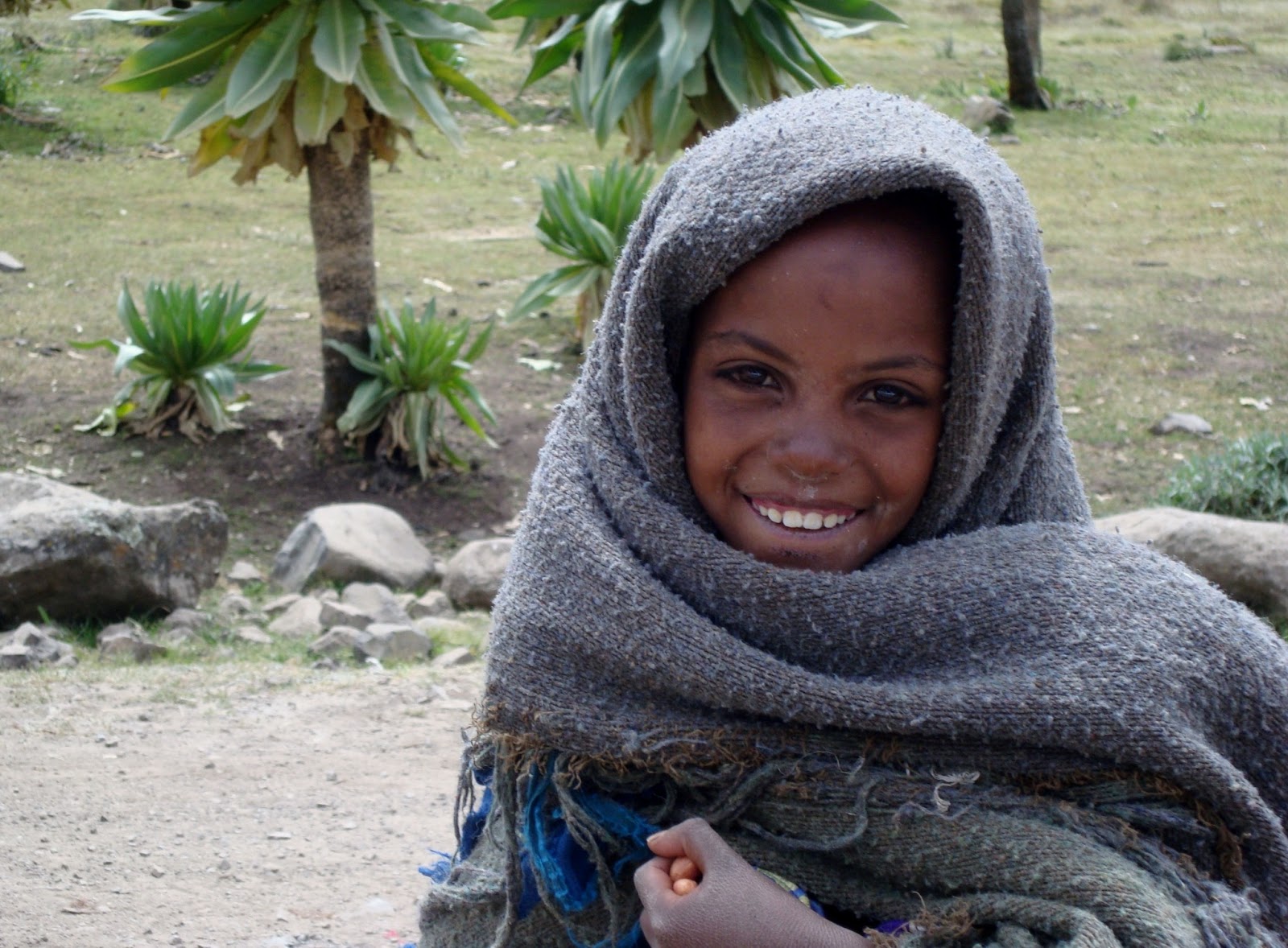
The local people here are some of the poorest we have encountered in Ethiopia so far and it is difficult to see children dressed in little more than rags and no shoes in such hostile weather conditions. This little girl in the picture below was one of them and when I bought a little handmade basket off her I was rewarded with this lovely smile.


 Yesterday we drove further north to a town called Axum which is widely regarded as being the spiritual capital of the Ethiopian Christian community. Although the scenery was amazing, the track (can’t really call it road) was one of those where you crawl over rocks for most of the day and it took us 10 hours averaging 25km/hour.  We were all totally exhausted when we reached Axum in the dark (broke that rule again!) but managed to find a clean budget hotel for the night.

Axum, which is in the very north of Ethiopia and close to the Eritrean border is said to be in possession of one of Christianity’s most important artefacts, namely the Arc of the Covenant. For those of you who are not familiar with the ‘Arc of the Covenant’ (and I was one of them), it is believed to be an ornate wooden box containing the tablets on which God wrote the ten commandments before handing them to Moses. It was thought to have been kept in Jerusalem before it was stolen by an Ethiopian king (the son of The Queen of Sheba and King Solomon) and brought to Ethiopia. It is now thought to be kept in a chapel in a church compound built on the grounds of the first Christian church ever built in Africa in the 5th Century AD. 


Chapel where The Arc of the Covenant is thought to be kept


 It is guarded by a single monk who becomes the guard aged 20 and stays in the chapel grounds until he dies.  This means that at any one time only one person alive has ever seen the Arc since its arrival in Ethiopia, although all the monk is allowed to do is to cover the box with an embroided cloth and take it off again on certain occasions. It is believed that if he (or anyone else) was to look inside the box he would die.
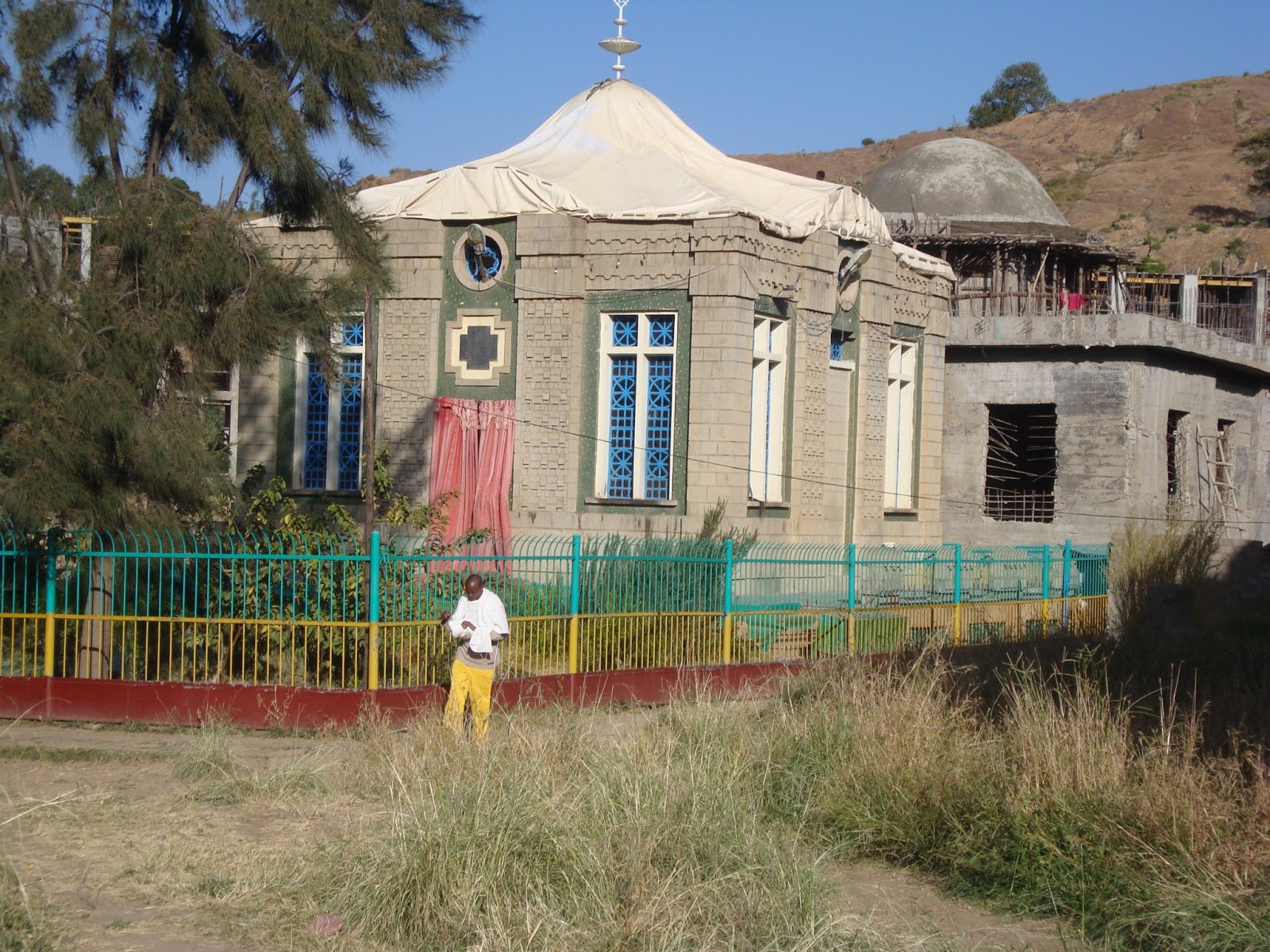
Of course it is not proved whether the Arc of the Covenant is really kept in Axum (or indeed whether it exists at all) and western historians generally don’t believe it is. And yet, it is impossible not to be caught up in the intrigue of it all. With the help of a local guide we got as close to the chapel as any person is allowed to be and yes, there was definitely a spiritual moment there.

The longer we are in Ethiopia the more we are captivated by its history.  Sudan and Ethiopia are the only countries we have visited so far with extensive numbers of ancient monuments pointing to ancient civilisations. And yet, Ethiopia’s official history is made up more of myths, legends and oral tradition than documented historical fact. Perhaps that is why it is so fascinating. Everyone you talk to is totally passionate about it and it is difficult to find a consensus when it comes to dating monuments or events even in the literature we are reading.


Sunday 28th October (Happy Birthday Dan!)

We left Axum and headed towards an area called Tigrai which is best known for its rock-hewn churches. These are churches literally carved into cliff faces and again, their history is surrounded by myths and legends. Some of them date back to the 5th century AD but no-one knows why they were carved into such inaccessible places. Some of them are so inaccessible that they can only be reached by being pulled up on ropes by monks. 

This particular one, Abba Yohanni,  in the two pictures below was almost impossible to spot and we very nearly missed it. Our guidebook described it as being '...build in a tall west facing sandstone cliff about three hours drive from the main turn-off'. If you look carefully you can just about see it in the very centre of the picture and this was our first sighting of it. Because the church is monastic, woman are not allowed to enter so we just took photographs. 


We visited two more churches, the first one was also very remote and thought to be the oldest.  We had to first find the priest who holds the key to unlock the door in a nearby village (who needed to be transported in Heather and Ian’s car sitting on the console with a guide sitting on the bonnet). We then climbed up a fairly steep but manageable rock slope and after a lengthy ritual opening a large wooden door found ourselves in a very small dark little church hewn into the cliff face.


It was absolutely amazing just being in such a place. I can honestly say that St. Peter’s in Rome did not have the same effect on me. The priest lit a tall candle to light up the murials on the walls and roof and the engravings of crosses and symbols into the rock. Unfortunately it was too dark to take any quality photographs on the inside.


Today is Sunday and we have treated ourselves to a slightly more upmarket hotel in a little town just south of Tigres. The longer we are in Ethiopia the more we want to see and an opportunity has just presented itself for us to join a group of people who are heading into an area called ‘Danakil Depression’ which is known for being the hottest and most hostile place in Africa. As well as having active volcanoes the landscape is a mixture of desert and salt lakes. 

One for the boys I think but will keep you posted! If only I could find internet access.


Tuesday, 16 October 2012

Sudan - The Red Sea


Sunday, 14th October

We have spent the last few days by the Red Sea and what a welcome break from the desert!  However, it took us a while to actually find somewhere to stay. This is probably the most astonishing fact of all since starting our trip: Sudan has a coast line of over 800 km with a coral reef stretching for much of its length and yet, apart from a couple of hotels in Port Sudan there is nowhere to stay along the entire coast. We ended up camping at the literally only ‘resort’ listed in the guidebooks, which was a complex of half built chalets and a couple of shaded areas where you could sit during the day. Luckily it had clean showers and toilets.


The first couple of days we just chilled doing very little. We knew the coral reef was out there, you could see a distinct line of colour change about one kilometre from the shore. We contemplated hiring a boat but it was very expensive. Eventually we set off ‘on foot’ with our snorkels. The sea was very shallow where we were and there was a little island halfway between the shore and what we thought was the reef. 


We reached the island and realised we only needed to walk or swim another 500 meters or so to get to the reef. At this point we started swimming since the sea became slightly deeper but still ‘walkable’. It felt like desert covered with sea water if that makes sense. The water was murky with sand and visibility poor.

About 20 meters from the edge of what we thought was the reef we put our goggles and snorkels on and were totally awe struck by what we saw in front of us; suddenly the colour changed into a clear rich blue and the ground dropped away about 30 meters deep revealing one of the most amazing sights I have ever seen. The water was crystal clear and I can only liken it to finding yourself  in a very large aquarium with fish of all colours and sizes and of course the coral. The water was so clear that you could see the floor of the sea. I don’t think I will ever forget the moment! It was just amazing!


I have put this image here (taken off the internet)just to give you an idea of the colours but of course it doesn't do it any justice at all.

Now Don and I are on our way back to Khartoum where we are hoping to extend our Ethiopian visas. Ian and Heather are on a slightly different route from us so for the first time since we have started our trip we are separated. Feels odd! We will catch up with each other in a few days once we crossed the Ethiopian border. 

Before I sign off I must share this poster with you, it was hanging on the door of a ‘european’ toilet telling people how to use it. We thought it was very funny. Can anyone work out what the last picture tells you ‘not to do’?


P.S. If you have any ideas please post your comments on the blog rather than facebook. Thanks guys!
                                                                        xxx


Monday, 15 October 2012

Sudan - The desert


Saturday, 7th October

We drove into Sudan a couple of days ago and were immediately struck by the difference in landscape and temperature compared to Ethiopia. Sudan is the largest of the countries on our itinerary and is mostly desert. Daytime temperatures have been hitting 45 degrees at midday and there is little cooling off at night. That, combined with the fact that we have had to leave all our alcohol behind (illegal in Sudan and punishable with 40 lashes if found in possession of) makes conditions let’s just say a tat more challenging.

The landscape is beautiful in a sparse desert sort of way and of course the boys love driving through the desert. Heather and I want to get the desert part out of the way and look forward to getting to the Red Sea which hopefully should be by the middle of next week.

We spent the first couple of days and nights in Khartoum, which at first sight is like any other African capital city we have been too. What is different is that there appear to be no other tourists here and the Sudanese treated us with a mixture of curiosity and hospitality; complete strangers come up to you in the street and want to shake your hand and want to have their pictures taken. We were in a park overlooking the confluence of the Nile (where the white and the blue Nile meet) when an elderly man came up to us and not only bought us all an ice cream (saying ‘that’s we do here’) but also invited us to go on a boat trip with him and his family. 


We left Khartoum yesterday and are now on a ‘loop’ on the north western part of Sudan following the course of the Nile where there are several historically important ancient sites. Yesterday we visited Sudan’s oldest pyramids and temples and although they are not as old and impressive as the Egyptian ones, what is amazing here is that there are virtually no other tourists. Sadly, an Italian treasure hunter arrived here over nearly 200 years ago and chopped the tops of each pyramid to look for treasurers. The treasurers he found are now kept in in a museum in Germany and the Sudanese are left with decapitated pyramids.


Sudan has no camping as such but you are pretty much allowed to camp anywhere is the desert. That we did last night and I have to say it was pretty special. The night sky is incredibly clear and it is almost eerily quiet.  We camped in the vicinity of the pyramids and again this felt slightly unreal, imagining an ancient civilisation of 20,000 living here over 2000 years ago. Nowdays, the area around them is totally deserted. 


Monday, 8th October

Yesterday we continued our quest to visit more ancient sites along the west bank of the Nile river. Again, we drove through mostly desert with the odd settlement of the ancient Nubian tribe here and there.  Due to the heat you don’t see many people outside but there is a touching tradition here of leaving water in each village for wary travellers.


On the outskirts of each village is a graveyard which is little more than a pile of rocks marked with a small metal plaque.  What a desolate sight!


This side of the river has virtually no road in places and it made our trek out of Kenya on the Marsabit road feel like a walk in the park. We drove 10 hours averaging 20 km per hour. The countryside changed from flat desert to what looked like giant rock forests. Don and Ian loved the driving and there was a distinct feel of ‘Lawrence of Arabia’ in the air. I finally understood why ‘men come from Mars…’


the 'road' through rock forest


What is incredible is that this is one of the largest rivers in the world and yet along it’s west bank in this part of Sudan we encountered some of the most remote areas so far.  I think very few tourists ever venture here.

After having spent Sunday night in a ‘hotel’ with so many creepy crawlies in our beds that we had to get the insecticide out to kill them first, we decided to bush camp in the desert again. South African friends of ours have often talked about the night sky in the desert but nothing prepares you for this. You literally don’t need a light to do your cooking etc.  It was magic!  At this point we were about 180km from Egypt and the night also marked our most northern destination having travelled 22,000 kilometres and 14 weeks to get here.
Sadly, we only had warm water to celebrate the occasion with!


our most northern point


Tuesday, 9th October

Before crossing the Nile to its east bank we visited one last ancient site. These ruins of an ancient temple date back to 3500 BC and were built by the Egyptians. Again we were amazed by how remote and isolated this spot was. I don’t think anyone has been here for weeks.


We crossed from the west bank of the Nile to the east on a ferry and having heard stories of old decrepit  ferries sinking we were glad to reach the other side, although the ‘captain’ reassured us that there were no crocodiles in the  river so I guess it would have been alright.


Now we are making our way across Sudan towards the Red Sea where we intend to spend a few days before heading back towards Ethiopia.  Looking out of the car window it is desert again, with a few rocks here and there. Just like in the picture below. I guess there is a beauty there somewhere...


Thursday, 4 October 2012

Ethiopia Part 2


Terraced grazing and growing areas at altitudes of up to 4000 meters


Friday, 28th September

We left Addis a couple of days ago and are now heading towards Sudan taking in some of the more northern ‘must sees’ in Ethiopia.

We ended up staying in Addis longer than we intended, mostly because we enjoyed staying at our camp, Holland House, right in the heart of the city. It is run by a Dutch guy called Wim who was one of the organisers involved in getting aid into Ethiopia during the Live Aid campaign lead by Bob Geldorf. What an interesting man with many stories to tell!  It is a camp which, on the face of it, you should totally not like and is worth a mention. It is no larger than our back garden and yet, by the time we left it managed to accommodate six campervans, a guy on a motorbike with a little tent, three dogs and a makeshift car maintenance pit. There was literally no room to swing a cat, and having to constantly navigate dog poo little room to put your feet.

The first night we were there a young couple right next to us had a massive row because he had fallen in love with another member of their travel group and when the noise finally died down the early morning Muslim call for prayers made sure we didn’t go back to sleep.


Dan, another 'overlander' who keeps turning up wherever we go


Across the road from the camp Wim runs a bar and here is where he, his Ethiopian wife and a couple of staff not only provide you with excellent home cooked food but also try and sort out your every query and need with amazing patience. Here is also where other travellers heading from south to north or visa versa meet to exchange information (similar to Jungle Junction where we stayed in Nairobi). What a lovely place! We left yesterday morning and said a temporary au revoir to Piet and Charlotte since they had to stay on for a few extra days to get their Egyptian visas sorted, but we expect to meet up with them again in Sudan.


We spent all of yesterday driving through mountain passes and valleys and were once again struck by the beauty of Ethiopia. With half of Ethiopia’s surface consisting of an elevated central plateau within the African Rift Valley you find yourself either on a mountain looking into a valley or in a valley surrounded by the most stunning mountain ranges. I have never seen so many shades of green. And no matter how steep, the mountains have been terraced to allow for grazing and growing crops.

We ended up staying in a ‘hotel’ in a little town in the mountains. We had a room with no window and we realised how accustomed we have become to sleeping ‘outside’ in our tent. It felt like a prison cell. I think when we get back we need to put up our tent in our back garden for a while to get used to living inside a house again.

Sunday 30th September

We spent the whole of yesterday in Lalibela which is one of the most important historical sites in Ethiopia. Lalibela lies 3,000m high in the mountains and is famous for it’s 11 rock-hewn churches, each one carved out of a single piece of rock almost 1000 years ago. Even if you are not religious it is impossible not to be amazed by the sheer craftsmanship and engineering; each church is below ground level and was carved out of rock from the top down. From the inside it looks like any conventional early middle age church like we have in the UK and services are held in most of them every Sunday or special Christian festivals.


Today we are on the road again heading towards the Sudanese border. There is so much more to see in Ethiopia but we have decided to get Sudan ‘out of the way’ since we couldn’t extend our Ethiopian visa and we will hopefully see the other sites on our way back.


The four us are unanimous in our passion for Ethiopia, it is so different from anything we have seen in the more southern African countries.  Not only is the countryside unbelievably beautiful but Ethiopians appear from what we have seen a very peace loving, friendly and happy nation, despite most people being desperately poor.  Most Ethiopians are deeply religious and with the country being roughly divided into Muslims and Christians, there appears to be no tension between the different religions. Well, we look forward to coming back here but are also excited about Sudan. We have spoken to people coming out of Sudan in a last few days and there is no sign of any trouble, in fact, the general opinion is that the Sudanese people are the most welcoming of them all. 

Tuesday, 25 September 2012

Ethiopia


We crossed into Ethiopia just over a week ago after a challenging drive on the notorious Marsabit to Moyale road out of Kenya. This is probably the worst road we have travelled on so far and yet, it is the main road between Kenya and Ethiopia.  It took us six hours to do 250 km and at times we were literally crawling over rocks. The landscape is mostly desert with the Great Rift Valley mountain ranges on the left of us. Every truck passing us totally engulfed us in sand like the one approaching below.


About half way into the journey we encountered our first sandstorm and you could actually feel the dust between your teeth despite all the windows firmly shut. It is hard to believe that people live in such a hostile environment but we saw these little settlements along the way so they obviously do.


The road is notorious also for random bandit activity so we were advised to form a convoy with other cars.  We teamed up with a South African couple, Pete and Charlotte, who are on a one year overland trip to Europe and who had been waiting just south of Marsabit to join a convoy. Apart from the terrible road conditions the country side was stunning and not something any of us had ever seen before. You can see for yourself in the picture below and imagine this 360 degrees around you with the odd camel here and there.


The day had been long and we were all relieved to reach the Ethiopian border. There we were kept waiting since the border officials had gone for lunch. This being the main border crossing from Kenya into Ethiopia!

We finally left the border post at 4pm and were slightly disheartened when our GPS didn’t show a campsite for at least 120km. It gets dark here between six and seven and one of our golden rules is not to travel in the dark. We pushed on feeling strong in numbers and were immediately struck by the difference in landscape. Everything was lush and green with the road winding up and down the mountains. And it was a tarred road which was such a relief. However we soon discovered that the main way of transport in Ethiopia is walking (bicycle in Malawi, moped in Tanzania) and walking in the middle of the road as much as possible. The same goes for dogs, goats, sheep and cattle.  We also noticed children of all ages suddenly running across the street right in front of our cars and found out the next day that this is one of their favourite dare devil games.  So were back travelling at impossible speeds despite the good road. Every few hundred meters or so you see dead animals lying in the middle of the road.

We reached our final destination at around 8pm feeling utterly exhausted. It was a lodge which didn’t really have a campsite but allowed us to camp in their car park just off the main road and use their toilets and showers. Heather and I reached a bit of a low point in our struggle with long drop toilets at this point. There is a thing here I have never seen before where the toilet is also the shower if that makes sense. So you go in to have a shower and someone will have just been to the toilet which is no more than a hole in the floor but you won’t believe the smell in some of these toilets/showers. In this particular establishment boys and girls shared and there was no way of locking the door.

As we headed further inland the next day the countryside became more and more spectacular.  What also strikes you is that everybody is busy here. Men are working the fields with ploughs pulled by oxen, you see children as young as five herding cattle and goats, woman carrying containers of water or bales of hey and firewood, sometimes bend over in half to cope with the load. Little girls carry babies on their backs. And everyone is smiling, with each other and with us.  When you stop anywhere the car is immediately surrounded by children who obviously want money, sweets or food but it is all very good natured and they are mostly excited to see foreigners. One little kid couldn’t stop stroking Ian’s beard. This little guy in the picture below jumped up to our car window and just wouldn’t jump off even as we made attempts to drive off. Look at that smile! My favourite country so far!


 Today is Thursday and we have been in Ethiopia for 4 days now. We are making our way slowly up to Addis Ababa which we would love to avoid but Don & I will try and extend our Ethiopian visas so there is no way around it. We have spent the last two nights and days in a camp called Paradise lodge and that is exactly what it was. It is a camp high up in the mountains overlooking a lake and on arrival we were greeted with a large drink of pure papaya juice and a damp hand towel.  For the first time in days we had the use of a proper hot shower and proper toilets, bliss! And a free laundry service so everything got washed whether it was dirty or not. Screws and bolts were tightened yet again after that terrible road out of Kenya. Yesterday we treated ourselves to a game walk with our very own game ranger.


Today we are on the road again and our destination is the Bale Mountain National Park which lies at an altitude of 4380m so tonight we will have to get the winter pygamas and hot water bottles out. We will literally be travelling 2000 meters up from where we are at the moment and expect a temperature drop of about 20 degrees. The highlight of this park is said to be a pack of Ethiopian mountain wolfs and the fact that you can drive all the way to the top with apparently spectacular views.

The South African couple who joined us in Kenya are still travelling with us. We are enjoying each other’s company very much and as long as we are heading in the same direction it makes sense to stay together. The great thing about overlanders/travellers is that you start sharing things the minute you meet them, tools, food, water, anything you have\need really.

view from our camp in Bayle mountains
our camp in Bayle mountains

It is now day three in our camp in the Bayle mountains and we woke up to a very wet day, something we havn’t really had to deal with so far. When it rains here IT RAINS!  Our camp is at an altitude on 2300 meters so it was very cold last night. Yesterday we took a drive to the highest point of the mountain range 4300 meters but sadly, when we got to about 4100 I got altitude sickness and Don and I had to head down again. The rest of the group managed to go all the way up. We did see two wolfs though so it was worth the trip.

It is now Sunday morning and I am sitting in our rooftop tent with a cup of coffee waiting for the rain to stop so we can pack up and move on. No internet access for the next few days so this blog is just getting longer and longer…

Saturday, 15 September 2012

Kenya - Nairobi


It has been a strange week for us in that we have done very little. We arrived back in Nairobi at the Jungle Junction camp on Sunday and are still here, planning our next move and waiting for our Sudan visas. This is quite an amazing place; it is a sanctuary for travellers from all over Africa. It has a workshop attached to it so the boys have had the cars serviced and all the screws and bolts tightened. There is also a fully equipped kitchen here so Heather and I have been pre-cooking and freezing meals for the next leg of our trip. And of course legs shaved and hair dyed (decision made!). We have also had a chance to catch up with family and friends which was great.

What is so special about this place is that travellers from all over Africa (and Europe) seem to know about it and there is a constant stream of people who are either on their way up north like us or on their way south and the info exchanged here is more valuable than anything you may read in your travel guides or hear in the news.

I took some pictures of other overland vehicles here since some of them are pretty unique. A few on them are for sale so I thought I would just mention it to our Oxford friends who said they would really like to join us on this trip...


Ben and Lin?

Steve & Julia?

Tony & Mel


Val & Jim? (sorry guys, nothing here up to your standard)

Joking aside, what we have learned this week from people arriving from the northern countries is that  a lot of the roads we would have to be travelling on from now on are impassable in the rainy season and it appears that the rainy season has started early this year so we may have to change our route accordingly. Or else there will be a lot of this:

Our first river crossing and guess who didn't get out to check the water level?
and here is why:


Finally the Sudanese visas have arrived and we are off again. From Kenya we will cross into Ethiopia before reaching Sudan; however, due to the fact that our Ethiopian visas expire by 22nd October, we have decided to make our way to Sudan as quickly as possible now and then spend some quality time in Ethiopia, Uganda and Rwanda on our way back down, hopefully with less time pressure.

Well, that was yesterday. Today we are keeping a close eye on the latest news and may yet decide to give Sudan a miss altogether if things are not stable by the time we are ready to cross the border from Ethiopia. Currently we are heading out of Nairobi as we speak and have been stuck in a traffic jam like the one you see in the picture above for hours. 

We managed to get out of Nairobi in the end, and are now sitting in our camping chairs at the base of Mount Kenya in a lovely camp. Tomorrow we will cross the equator so we will need to find a bath to see which way the water drains. Will let you know...