Wednesday, 18 March 2015

Thursday 11th March, The Kaokoveld


We have now traveled to close to the far north western corner of Namibia and are currently staying in an area called Marienfluss which lies at the heart of Kaokoland. Our Northern border is once again the Kunene River with Angola across from it. At this point the river is so narrow that you could easily swim the distance in 2 minutes, were it not for the crocs.

Kaokoland is one of Namibia’s remotest regions and has a totally prehistoric look and feel to it. The landscape is semi-desert and ranges from rugged mountains and dry riverbeds to vast sweeping plains. It is incredibly hot here; we measured temperatures in the low to mid forties and the air is very dry and hot.


 Everything here has over time adapted to the harsh arid conditions and the plants and trees which do exist here are something none of us have ever seen before. Also in this region are the endangered desert elephants which have long spindly legs, suited for long walks in search of water.


This area is also home to the semi-normadic Himba people, who are best known for smearing a mixture of ochre, butter and bush herbs over their bodies which protects them from the sun and insects. They have so far resisted most outside influences to modernise and still live like they have done for generations, herding cattle and goats and living in very simple huts which have the appearance of large beehives.


With this area being so isolated and there being no phone signal for miles it appears that the way to communicate with your neighbours is to strategically place a pile of rocks in the vicinity of your homestead. At least that is what we think these strange configurations of stone are:


At the heart of Kakaoland lies an area called Marienfluss which is really hard to describe. It is a valley stretching 120 km from south to north and is like an oasis in the middle of a desert. Since it is almost totally flat, not unlike the salt pan in Etosha, and surrounded by mountains, it feels like you are in a giant cathedral. During the wet season, the dry hot soil is apparently transformed into a lush green landscape stretching out for miles, however, we only saw it at its driest and hottest.


Adding to the mystique of this place are hundreds of what has been termed ‘magic circles’ which are perfectly formed circles in the soil where there is no vegetation at all. There are many theories as to what causes this phenomenon but nobody actually knows.


There are two routes into this valley, the ‘shorter’ but very steep six hour Van Zyl pass which is a 4x4 challenge only for the most experienced drivers and then there is the slightly longer but less steep route.


Van Zyl pass from the top

There was much debating which route to take over the campfire the night before but when it became apparent that Heather and I would actually have to walk in front of the vehicles (backwards!) to find the safest route down, we declined (the pass is made largely of loose rocks and requires a ‘spotter’ to mark out the route).

So we went the long way. It took us almost two days of driving to get here but we all feel it was worth it. The drive itself is a mixture of rock crawling, sand driving and teeth rattling corrugation skimming, averaging speeds of no more than 20 miles per hour with the most stunning scenery. Each time we came across a particularly challenging pass, Don muttered ‘Ed would love this!’  We must have crossed about thirty or so riverbeds, luckily all of them dry. Except one!

After leaving Etosha Game Park we made our way towards this most north western corner of Namibia via the Epopa Falls. We made an early start the next morning after a night of heavy rain. When we got to the river we encountered our first flash flood ‘wet’ river bed and not only had the bridge been washed away but the water was flowing so fast that there was no way we could cross. So you wait.


 Heather used the time to do her laundry and I was reading. We were soon surrounded by Himba people who came to observe the spectacle. Several 4x4’s were waiting to cross but no-one wanted to be the first one to go. 


After waiting for at least six hours and there not being any sign of the water level dropping sufficiently we decided that today was not the day. So the boys wanted to set up camp for the night right there, by the river, Voortrekker style. Heather and I reminded them that we were not actually travelling in ox-wagons and they finally (reluctantly!) relented and we turned back and spent the night in the nearest camp. The next morning the water level still hadn’t dropped so we headed upriver looking for a safe place to cross. We eventually found a spot and made it across. Phew!


Tomorrow we are starting our journey south along the Skeleton Coast. Unlike in Sudan, where we celebrated our most Northern point with stale warm water, tonight we celebrate with cold beers. 

Monday, 9 March 2015

Thursday 5th March – Bushmanland


We have just left Khaudum Game Reserve and are on the road towards Etosha Game Reserve, traveling through the heart of Boesemanland (also called Bushman land). This area is home to the largest remaining community of indigenous Bushmen or San people who still live on their ancestral land, the Nyae Naye  Conservancy. The San people occupied Southern Africa long before black and white settlers invaded their territories. Most are still very traditional as they have only had contact with western civilisation since the 1950s. There is archaeological evidence that San people were present in Namibia as long back as 20,000 years ago and they left evidence in the form of rock paintings.


Khaudum deserves a special mention since even before entering it you feel some kind of awe. The guidebook describes it as ‘an intense wilderness challenge’ mostly due to the deep sandy trucks and the fact that there is no signage and you are mostly reliant on your GPS. 


So we spent two full days meandering through deep sandy trucks. Because of the tracks having been pre-formed by previous vehicles, you swerve from side to side the whole time which at times feels like you are swimming on the sand. Of course the boys loved it!

Luckily we didn’t get stuck once so none of the big toys (winches, tow ropes etc) were needed. Nevertheless, it still took us all day to travel from the northern entrance to the reserve to the southern exit, travelling mostly in second year with the engine being tested to its limit.

We had plenty of animal sightings, mostly elephant. In this park you keep a respectful distance since there is no quick get-way due to the sandy tracks.


Before Khaudum we had stopped for two nights in a quirky little camp on the Okovango River. It had a caged swimming pool immersed in the river to protect you from the crocs and hippos so we had our first swim on this trip.


As you enter the camp there are a couple of amusing signs:


And this one is for you Ed (says Don):


Und Tante Tillia das ist unser Hotel:


So now we are on our way to our last game reserve in Namibia, Etosha.

For the last four days I have been totally deaf in one ear, so the highlight of the trip so far has been having a goggo (small insect) ,which must have climbed in and made a little nest in my ear, flushed out by a doctor in a little town that we stopped at along the way. Phew, what a relief! It was my right ear and since Don’s hearing isn’t great either, some of our dialogues in the car were priceless!

Sunday 7th March Etosha Game Reserve


This morning we left Etosha after a couple of great days of game driving. The highlight for both of us was literally stumbling (at low speed, in our truck) on three adult young male cheetah as we turned a corner on a fairly desolate track. The sighting literally took our breath away since neither of us had ever been this close to a cheetah, let alone three. They were not overly perturbed by us at all and were in no hurry to get away, so we had the privilage of watching them for at least twenty minutes before they ambled off into the bush. Amazing!

Unfortunately, Ian and Heather were on a different drive and out of radio range so we couldn’t share the experience with them.


Etosha is mostly famous for its large salt pan, a dried up saline lake covering an area of nearly 5,000 square kilometres. Thousands of years ago the Kunene River would have fed the Etosha lake but now it has dried up forming a gigantic salt pan, except for a few days a year when it is converted by rains into a shallow lagoon teeming with flamingos and pelicans. The view across this extensive expanse of desert flatness is truly incredible and cannot really be captured by a photograph, but this is what it looks like anyway:

From this point the pan stretches out for 130 km

Etosha really is teeming with wildlife and apart from the Cheetah we saw black and white rhino, a lioness and lion with a recently killed zebra, plenty of giraffe and zebra and the usual assortment of  game.

We are now making our way to the north western corner of the country near the Angolan border before turning south along the skeleton cost.

Monday, 2 March 2015

Namibia - Mudumi Game Reserve

Friday 27th February

Mudumi Game Reserve Booking Office

We crossed the border into Namibia two days ago and spent a couple of nights in a campsite by the Chobe River within the Caprivi strip, this time with Zambia (no longer Botswana) on the other side of the river.  It was our first full ‘rest day’ since we left Ingogo and it was good to have time to catch up on clothes washing, plan the next stage of our trip and we also had our first internet access.

We then moved on to the nearest town Kamilo Malilo to stock up on reserves for the week ahead. The plan is to visit three game parks in succession and since neither of them provide any facilities you need to be self-sufficient to enter them, including your own water. Because of the heat, Don and I are between us drinking about 4 litres of water a day at the moment.

It is now day two in the first game reserve, called Mudumi. We have set up camp in a sheltered spot by the river where Ian and Heather had stayed before, after we had separated from each other at the end of our previous trip in Tanzania two year ago. They had liked it so much that they ended up spending an entire week here.  Other than a ‘longdrop’ toilet there is nothing here, just wildlife all around and those awesome hippo sounds in the night.


This is supposed to be the rainy season but currently everything is very hot and dry. All the way since leaving Ingogo we have seen miles and miles of mielie (maze) crop struggling to survive due to the lack of rain.

Anyway, so last night halfway through our braai the rainy season started (for us, anyway). The rain came so suddenly and so intensely that we had to abandon supper and head for our rooftop tents hungry.  Luckily our tent stayed dry in the night, Ian and Heather’s got rather wet. The only upside of it was the fact that we managed to collect about 30 litres of rain water in various containers. Beats washing in river water!

Woke up with curly hair this morning (from the rain I think) and decided to have my hair cut by the only hair dresser for miles.


Sunday 1st March,

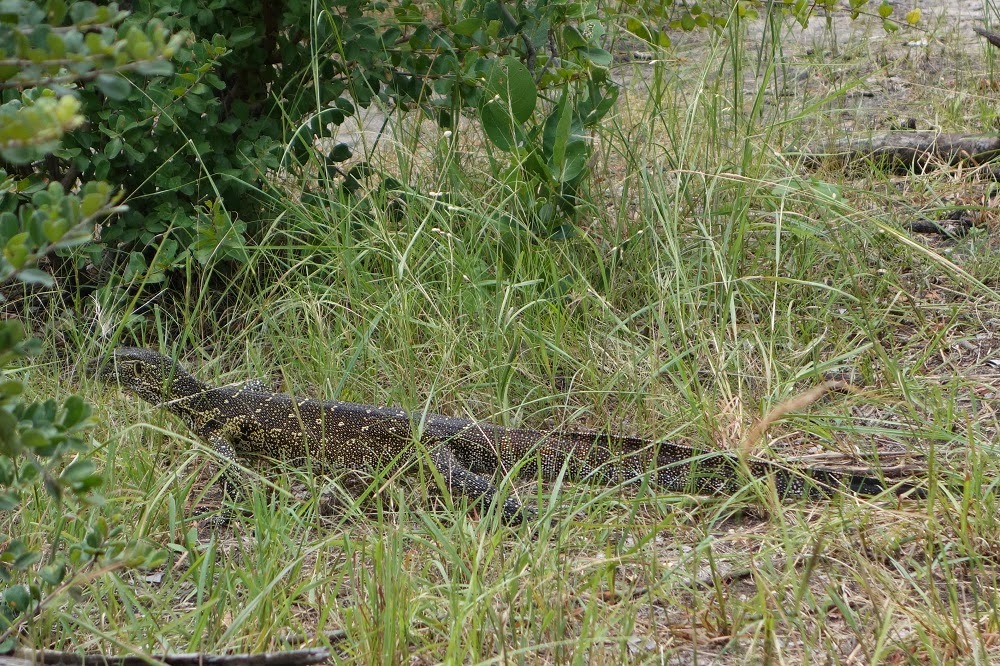
We spent all of Friday driving around Mudumi game reserve. It is a mixture of swampland with very long grass and ancient forest. Apart from elephant and the usual game we came across this rare creature called Leguavaan which Don was very excited about. It is about a meter long and so well camouflaged that you would never see it unless it was moving.


It was one of the hottest days so far and driving at five miles per hour in this heat was a challenge. So we were very excited when we got back to our camp where Ian had been busy rigging up a bush shower. Bliss!


And here is the view from the shower:


We left Mudumi yesterday morning and drove some 50 km south to the second camp called Mamili. This one differs from Mudumi in that it is almost entirely swampland and usually 90 % of it is submerged in water at this time of the year. However, because of the lack of rain it was very dry and it appeared like most of the animals had migrated across the Linyati River into Botswana. Nevertheless, the countryside is stunning with all different coloured tall grasses.


.
 We found a nice little camp for the night with a basic shower and toilet, so us girls were happy J

Halfway through the night it started raining heavily again and for the first hour this morning we didn’t even get out of our tents since everywhere around us was mud. When we eventually did get out we found that although it was wet all around us, there was no water in the tank feeding the showers or the toilet. We sat around drinking coffee and making poached eggs (thanks for the egg poachers Ed and Sandy, used for the first time today!) when the camp guard appeared, trying to pump the river water into the overhead tank, only to find that the pump was not working and Don and Ian stepped in to fix it.


The guard had believed that the pump had been broken, so he was very happy to have it working again. He treated us in turn by heating the river water for  a hot shower and since we were still wet and for the first time even cold, it was a real treat.


Next we are planning to make our way to the Okavango River, where we will leave the Caprivi Strip and then make our way westwards to our third Namibian camp, Kadum.

Wednesday, 25 February 2015

Botswana - Chobe Game Reserve

Tuesday 24th February


 Yesterday we spent all day exploring Chobe game reserve, one of Botswana’s largest national parks. It is about 10,700 square kilometres in size and forms the northern border of the Kalahari Desert. It was originally inhabited by the Bushmen and is now home to the largest elephant population in Africa and you almost run into either a single elephant or a herd at every turn. We came across one herd right in front of us where a large male elephant was blocking us from driving on until a female with her tiny calf had safely crossed no more than five meters away.


There are very few ‘self-drives’ here and most of the organised tours go into the park early in the morning or late afternoon so when we entered at around 9am we didn’t come across a single other vehicle all day.
We stayed close to the Chobe River, which forms the Park’s northern boundary, for most of the day and apart from numerous elephant we came across a flock of vultures devouring what looked like a small elephant. The stench was unbearable!


At some point we headed inwards into a ‘valley’ where the bush was very dense and it felt like complete wilderness. Here we came across a recently killed buffalo with vultures still circling in the sky waiting their turn.

We enjoyed the day enormously but with temperatures in the late thirties I found it also exhausting.
We got back to camp feeling a bit like to guys in the picture below and I was glad it was Heather’s turn to cook supper and no, we didn’t have fish!


Last night in our camp in Botswana, leaving for Namibia tomorrow

Botswana


Friday 21st February, Botswana


It is almost two years to the day since we finished our last trip. Having arrived from the UK last Sunday we spent the first few days getting ready. How much easier it has been to plan and pack for a six week trip rather than a ten months one; no winter clothes to pack and only two guidebooks instead of nine! 

We were pleased to find that our truck had not suffered from being left out in the open since we last used it and apart from a family of rats having made a nest in our solar panel sleeve, things were pretty much how we left them. Don had stuffed about 20 packets of moth balls into varies nooks and crannies of the truck and getting used to the smell took a bit of getting used to.


So we set off from our base at Ingogo two days ago, heading firstly north towards a town called Lichtenberg. Don and Ian spent most of their childhood there and hadn’t been back since the family relocated to Natal 50 odd years ago. Between the two of them they remembered the name of the street and the number of the house and we actually managed to find it.  The basic building was still standing but had been added on to and is now enclosed by a six foot wall.


We spent our first night in our rooftop tent for over a year and even though we camped in the vicinity of a cement factory it felt great to be sleeping ‘out in the open’ again. From Lichtenberg we headed northwest across what is locally referred to as bushveld country towards the Botswana border and had a reasonably uneventful border crossing. The biggest challenge of the day was the temperature, hitting 41 degrees by early afternoon.

Last night we stayed in a nice little camp near Gaberone, the capitol of Botswana. It was our first night in the real bush and we were greeted by a large resident elephant as we drove in. Unlike game reserves in South Africa, here the animals are pretty much free to roam without boundaries and it is not uncommon to see them crossing the road (even the highway) in front of you.


Right now we are on the main south to north road, hoping to reach a camp near the northern Botswana border by the end of today, so pretty much driving all day. We have made the collective decision to drive through Botswana towards Namibia without too many stop overs. Mostly because we want to spend as much time as possible in Namibia and explore Botswana another time.

Monday 23rd  

Having spent two days driving on good tarred roads we were in need of a ‘road less travelled’ and took a detour on a remote dirt track which snakes along the Zimbabwian border to the east and close to the Hwange game reserve (which is in Zimbabwe). 


It took us six hours to cover 110 km and for the first time on this trip it felt like we were ‘on the road’ proper. It being so close to the border we were warned of possible poaching activities but apart from some anti-poaching soldiers suddenly jumping out of the bush in front of us waving their guns (a heart-stopping moment on my part!) we saw no-one along the entire route; just beautiful countryside and the odd elephant here and there. Most of the time we were driving through grass as tall as our bonnet and had to stop every now and then to clear grass seeds  and stalks that were trapped in the radiator.


the scull of an elephant by the side of the road


We spent the night in a nice little camp on the Chobe River where warthogs wander around your truck, monkeys steal anything they can and hippo are on the river bank right up in front of you. Across the Chobe River you look at the Caprivi Strip which is a narrow stretch of land jutting out eastwards from Namibia, which separates Botswana from Zambia. With Zimbabwe 60 km to the east, this part of southern Africa is a junction point for four countries.


view from our camp towards the Caprivi Strip


Tomorrow Don and I will take a drive into Chobe game reserve while Ian and Heather will do some fishing.