Thursday, 7 February 2013

Tanzania via Burundi


Wednesday 30th January

We spent our last night in Rwanda camping in yet another hotel car park near the Burundi border. Like Uganda and Ethiopia, Rwanda has no campsites as such and the best you get is being allowed to stay in the car park of a lodge or hotel but have the use of the bathroom and other facilities.

Burundi was always intended to be a waypoint for us simply to get from Rwanda back into Tanzania so we never intended to spend much time there. Like Rwanda, the country is very small (28,000 sq km) and can at a push be crossed in a day. On top of this, we were only granted a three day transit visa at the border, so we literally only had sufficient time to pass through the country.

The landscape is very similar to Rwanda, hilly, green, yet slightly more disorganised. Its major landmark is Lake Tanganyika, which runs along its entire eastern border (and continues along neighbouring Tanzania in the south forming it’s entire eastern border as well).

We spent Saturday night camped in the grounds of a very nice lodge (Pinacle 11) which is located just beyond the outskirts of Bujumbura (the capital city) on the most northern shore of the lake. Although the view was not that spectacular in itself, the setting certainly was, ‘sitting’ in the middle of the Great African Rift Valley with mountains on both sides of us (DRC to the right) and the entire length of the lake stretched out before us (all 680 km of it!).


We then travelled most of Sunday, heading south along the Lake shore towards the Tanzanian border. We were tempted to visit the southernmost source of the Nile in the south of Burundi (where it is nothing more than a trickle) but were deterred by stories that the rangers there may take your money but may not actually take you to the real source (but to a more accessible ‘alternative’). So we decided to give it a miss.

Sunday night was spent at yet another car park of a lakeside lodge; a lovely lodge with a spectacular view, but hopefully the last car park for a while since all the countries south of us cater for campers.

We crossed into Tanzania on Monday and headed straight for a camp just south of Kigoma (Jacobson’s camp) and what bliss to be able to make a fire and cook our own food again.  The camp is situated right on the water edge of Lake Tanganyika and we had our own little beach to ourselves where we spent our first night braaing a local fish (a Kahue) bought from a passing fisherman. Absolutely delicious! From here we also had our first glimpse of the MV Liemba, a ship I will tell you more about later on.


Sunday 3rd February

We ended up staying at Jacobsen’s camp far longer than originally intended and only left on Thursday, continuing along the road heading south along the lake. During our stay at Jacobsen’s we visited one of the main tourist attractions in the area in a town called Ujiji, where the historic meeting between Livingstone and Stanley took place in 1972 (Stanley supposedly having greeted Livingstone after a two year search for his whereabouts ‘Mr. Livingstone, I presume’).

From Kigoma, the road continues south but heads inland so we didn’t see the lake again for several days. We rattled along on tracks which were mostly dirt road and in some places would have been impassable had it been raining. There are very few settlements along the way and the countryside is mostly indigenous bush.

We reached ‘Riverside camp’ after an eight hour trip covering no more than 150 km (!). This camp is on the edge of a national park called Katavi. The campsite itself is located on the park’s boundry, separated from it by a river which at this point forms a large pool and as we drove in we were greeted by the sight of about 10 hippos lazing in the pool. We could walk right up to about 20m from where they were and watch them which was a real treat (and were watched in return as in the picture above).

We spent the next day in Katavi game park which is mostly inaccessible in the rainy season but because the tracks were reasonably dry we decided to risk it and ended up having a great day with many sightings of yet more hippo, an enormous herd of approximately 600 buffalo, six females lions resting under a tree by the side of the track and many others. This could be our last game park for Don and myself on this trip so it made it extra special for us.

We left yesterday to continue our journey south. Our next destination was a Lodge we had heard about from other travellers, located on the lake, called Lakeside Lodge. It is an absolute jewel in every possible way. As you drive in you are greeted by a sign saying: ‘Come as a guest, leave as a friend’, and that pretty much sums it up.

The whole place is designed with an African Zen touch and after having been ‘roughing it’ (and loving it!) for the last eight months, it feels like total luxury. This is probably the first time on this trip where I haven’t had to keep my flip-flops on to shower. We are camped right on the Lake under a huge Mango tree and out of one ‘bedroom window’ we can see the lake and the other three are surrounded by the tree.


I think I have posted enough sunsets in previous blogs, so I have decided to show you some pictures of our beautiful Zen bathroom:


fresh flowers in the toilets!


 Thursday, 7th February

Well, we are still here at Lakeside Lodge!

The moment was always going to come where we (Ian & Heather, Don & I) would go our separate ways and gradually our conversations around the fire have changed from ‘Where shall we go tomorrow?’ to ‘What was your best/worst moment, experience’ etc.  So we decided that this is the place where we will part company and head in different directions, Ian and Heather (who still have four months of their travel time left to burn) towards Malawi, Don and myself starting our long trip (3,000 km) back to South Africa before flying back to the UK. We have decided to travel via Zambia (which should be quicker than travelling through Malawi), then stop at Al and Joy’s in Zimbabwe for a couple of days before driving on to Johannesburg and finally Durban.

But there is one more adventure we are going to embark on together and that is to take a cruise on Lake Tanganyika on the MV Liemba starting at midnight tonight. With there being no roads or tracks to speak of along the entire lake, the Liemba is the only lifeline many villages have with the outside world. It runs the entire length of the Lake (starting in Zambia and ending in Burundi) once a week, stopping at several small ports along the way. The ship is too large to dock so everything is ferried  to it by small boats and passed up into the ship, apparently quite a spectacle.

We don’t know what to expect since this steamer not only carries people but also livestock and just about anything that needs to be transported up and down the lake. It is also nearly 100 years old and has already spent 10 years at the bottom of the lake after it was deliberately sunk by the Germans (who owned it) rather than let if fall into enemy hands. In 1927 it was brought up from the bottom of the Lake and has been doing it’s weekly journey ever since.

We have booked a the VIP suite (just in case!) and I have packed my tiara and evening gown and Don his tuxedo, so Ben and Lyn, this could either be the beginning or the end of our cruising experiences.

We will keep you posted when we get back on Sunday!

Sunday, 3 February 2013

Rwanda - Part 2


Thursday, 24th January

After my amazing experience with the Gorillas we left our camp in the foothills of Park the Volcanoes and headed south along Lake Kivu. Like all the lakes and just about everything in the Great Rift Valley, Lake Kivu is no ordinary lake. It is known as the ‘exploding lake’ which has in the past experienced violent eruptions. This rare event occurs when volcanic gases, which are trapped deep in the lake, suddenly erupt, suffocating all life in the vicinity. The last recorded eruption occurred in Lake Nyos (Cameroon) releasing over 80 million cubic meters of CO2 and killing 1700 people. Lake Kivu is constantly monitored and currently the water pressure exceeds the gas pressure so all is well.

We camped at a nice lodge (Paradise Lodge) right on the edge of the lake with amazing views of the mountains in the DRC in the distance (too dark to see them in the picture below).


From here we headed inland towards Kigali, the capital. The main purpose was to see the Kigali Memorial Centre which we visited yesterday.

It is a deeply moving experience and despite having read a fair bit about the 1994 genocide beforehand, some of the facts are simply incomprehensible:

  • 1,000,000 people were murdered in 100 days, that is 7 people per minute
  • Ordinary people turned on each other, neighbour on neighbour, friends on friends and even family members on their own
  • 30,000 children were orphaned.
  • In some areas only 1 in 10 Tutsies survived.
  • As the genocide neared its end, it is estimated that over two thirds of the population of Rwanda was displaced. 
  • The number of refugees was over 2 million (about 10% of the total population at the time). One of the difficulties facing humanitarian personnel in the refugee camps was the fact that many ‘refugees’ were in fact perpetrators fleeing from what they feared would be reprisals.

There are many more gruesome facts and images but the exhibition also pays tribute to some acts of heroism.  Many survivors offered to take orphans into their homes and it is not uncommon to find homes with large numbers of young people living with what were then complete strangers.

And then there is the story of Paul Rusesabagina, which is told in the film ‘Hotel Rwanda’. As the situation in Kigali reached its boiling point, and the streets were littered with bodies, Paul risked his own life and that of his family by allowing fleeing Tutsies and moderate Hutu to take refuge in the ‘Hotel des Mille Collines’, which is right in the heart of the city and where he was left in charge after the hotel’s European managers were evacuated.


The final message is that ‘Rwanda is determined to work towards Reconciliation’ but as an outsider, one is left wondering how that can be achieved given that many families alive today have someone who was either a victim, a perpetrator or a collaborator.


Sunday, 27th January

We left Kigali and continued south along Lake Kivu.

Rwanda is beautiful, a country of hills, mountains, forests and lakes.  It is also tiny, some 26,000 square km of land and one of the most densely populated places on earth. It is frequently referred to as ‘The Land of a Thousand Hills’ and driving through the country side it is obvious why. You very rarely find yourself on a horizontal road, you are either on the way up or down a hill. There are even hills sticking out of the lakes like in this picture:


The soil is very rich and like Ethiopia, every bit of land is cultivated (except for the National Parks). The whole country looks to some degree like a gigantic garden and everyone is busy attending to their crops. The main things growing here are tea and coffee and you will see very neat, almost manicured, tea plantations stretching over several hills and valleys.


We headed east towards the Burundi border and passed through the Nyungwe National Park but decided not to stop due to the large fees. The park is an ancient rain forest, is famous for it’s biodiversity (it claims to have survived the last ice age!) and is home to around 500 chimpanzees.

The 100 km road passing right through the park was nevertheless a pleasure to be on, surrounded by these ancient tall trees.

Our next planned stop was the Gikongoro Genocide Memorial, which is a former technical college where 50,000 Tutsies fled but were brutally murdered within a few days. Due to the sheer numbers, hand grenades were thrown through the windows in order to flush the people out who were then killed, mostly with machetes. The bodies were then dumped in the college ground in mass graves.


Many of the bodies have been exhumed, preserved with lime and are displayed on the floors of the classrooms and appear exactly as they did when they died with the marks of machetes still visible on many bodies.

Needless to say it is a totally overwhelming sight, especially with so many children and babies amongst the bodies.

I will remember Rwanda for the best and worst moments of this trip.


Thursday, 24 January 2013

Rwanda - The Gorillas


Monday, 19th January

We entered Rwanda last Friday and headed for a national park called ‘Parc National des Volcans’ which runs along Rwanda's borders with the DRC and Uganda. This park has five towering volcanoes as it’s backdrop, is home to Rwanda’s mountain gorillas and is also the place where Diane Fossey conducted her research and where the movie about her work was filmed (Gorillas in the Mist). During the seventies, Diane Fossey, who was influenced by the conservation work of Jane Goodall and Louis & Mary Leakey, embarked on a massive publicity campaign to save the mountain gorillas from extinction. Before her campaign, stuffed gorilla heads and hands (used for ashtrays!!!) were widely available as souvenirs.

So it was no wonder that ‘Gorilla trekking’ was back on our minds. 

The number of daily permits to see them is strictly controlled so as to minimise the impact of tourists on their habitat and it is usually difficult to get a ticket without having booked long in advance. Well, guess what?

Don and I took a drive to the booking office and tickets were available for the following day. Ian and Heather and also Don had declared themselves out so it was just me. Seeing the gorillas in their natural setting had been top of my ‘bucket list’ so it is hard to describe how excited I was. Needless to say I hardly slept that night.

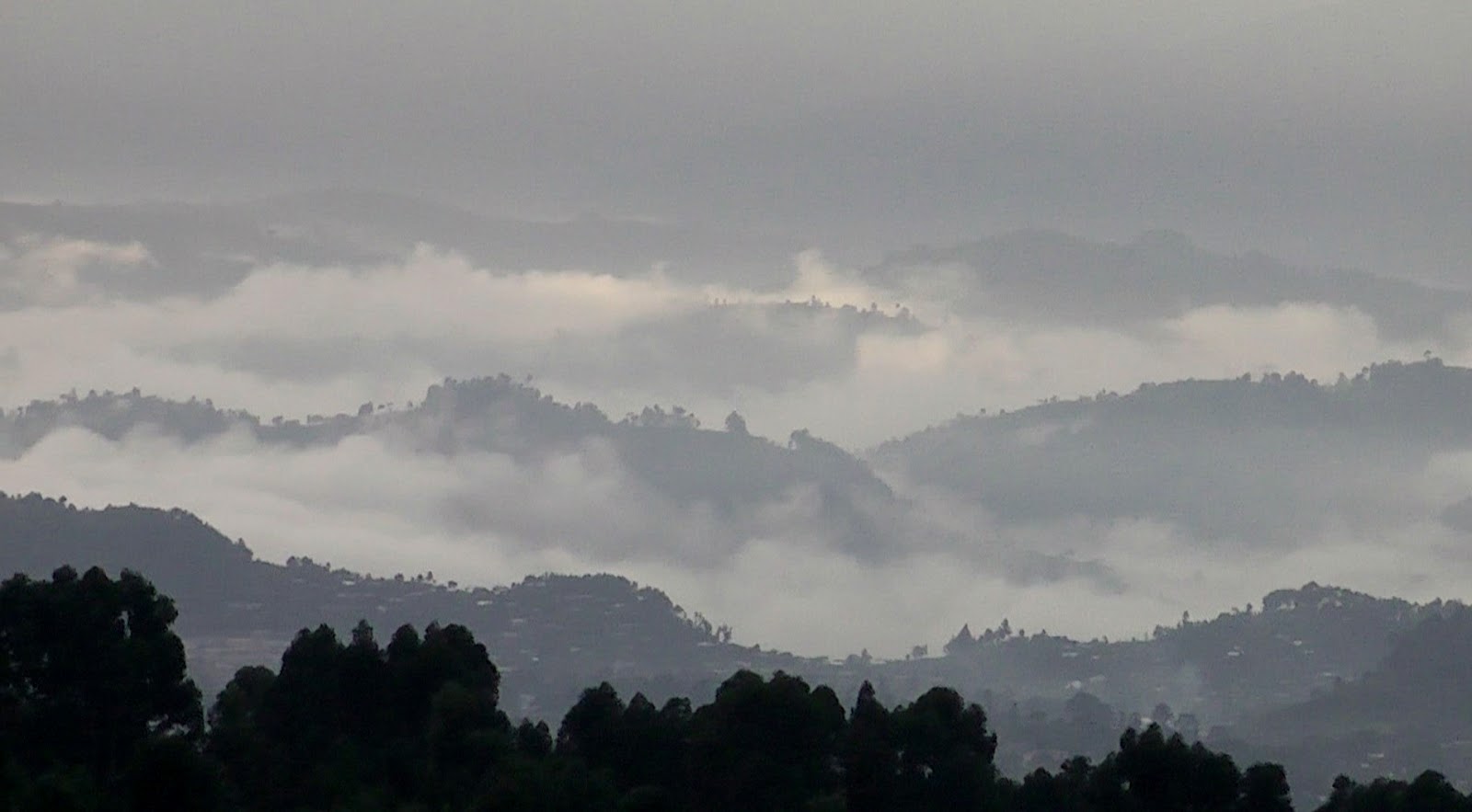
We set off far too early to make sure I would get there in time and as we left our camp the mist was rising in the valley and it looked like this:


This particular park is home to twelve mountain gorilla families and numbers to trek them are restricted to eight people in a group per gorilla family. The difficulty rating for the trekking ranges from relatively easy to hard, depending on how high up in the mountains the particular group you are observing resides. Of course they move around a lot but apparently most families stay within a range of about five square kilometers.

I was assigned to a 'medium' group and there were only two other people in this group. So off we went. The park is mostly rain forest and lies on the lower slopes of the volcanoes but to reach the perimeter of it involved a two to three hour steep climb. One of the woman in my group was not able to cope with the strain so she turned back (leaving just two of us, plus our guide).

We reached the edge of the park and were joined by another two guards armed with rifles. That was because the park is also home to buffalo and elephant. Just as well, as soon as we entered, our guards had to chase a buffalo away which had been hiding in the bush.

Another hour or so of serious trekking, this time no foot path, just jungle type vegetation and the guard was ‘cutting’ the path with his panga. This part was very tough, there was little visibility, we were surrounded by six foot tall stinging nettles and you had no idea where you were putting your feet due to the undergrowth. But I was too excited to worry about snakes and spiders!

And then suddenly the ranger stopped and signalled to us that we had located ‘our’ family. We carried on for another ten meters and there they were; a huge silverback, four females and a six months old baby. That first sighting of them was unbelievable!


Park rules stipulate that one should get no closer than seven meters but since our family was resting in a small clearing we were close enough to touch them but of course that is not permitted. However, the baby was very curious and kept coming towards us and gosh, I would have loved to pick it up!


...not unlike my own Silverback...


We were permitted to spent an hour with them and it went in no time at all. I don't know whether it was that they were 'resting' or not, but they were incredibly docile and apart from the baby running around and coming up to us, didn't take much notice of us at all.

Wow what a day! I have wanted to see the Gorillas ever since reading about their plight in the seventies and here I was....

                                                   ...another tough day in Africa!

Sunday, 20 January 2013

Uganda - Murchison Falls and Rwenzori Mountains


Saturday, 11th January

Uganda is turning out to be one of our favourite countries so far and we are finding that the longer we are here the more we want to see. The only problem is that we now have a time limit. We have finally booked our flights home for early March and we still have to cover 5000 km just to get back to Durban.  Ian and Heather have until the end of May before they head back so at some point in the next few weeks our ways will have to part and Don and I will probably head back in one long stretch just so that we can delay our parting and maximise our time together.

After our water-rafting adventure we stayed at the ‘Nile Explorer’s camp for a couple more days.  It is one of those great ‘over-lander hang-outs’ where the longer you stay the harder it is to leave. This particular camp has the most amazing views over the Victoria Nile river; it is set high up on a hillside and the sunsets are some of the best we have seen so far.


We left the camp on Wednesday and headed north west to visit the Murchison Falls, another dramatic natural spectacle, where the entire Victoria Nile River is forced through a six meter gap in the rock to plunge into a frothing pool below with unbelievable force. It is almost impossible to capture this with a still picture since the sound is even more impressive than the sight.

We first took a boat to view the falls from the bottom and had many sightings of hippo, crocodiles, a lone elephant and an abundance of birds. The water at the base of the falls is so turbulent that the closest you can approach the falls is what you see in this picture.


Viewing the falls from the top is amazing. You can hear the droning sound a few hundred meters away and you get a real sense of the enormous force of the water partly because you can get right up to the water’s edge.


After visiting the falls we first travelled east to the confluence of the Victoria and Albert Nile Rivers and then headed south for a couple of overnight stays along the shores of Lake Albert, which forms the border between Uganda and the DRC. Our aim was to slowly make our way towards Rwanda but as we reached the Rwenzori Mountain range on our right (which forms Uganda’s border with the DRC), we decided to stop and explore.

The Rwenzori maintains are the tallest mountain range in Africa and several of the peaks are permanently covered by ice and glaciers, despite the fact that the mountains are located on the Equator. The view of the peaks is especially amazing since the white tops are covering black volcanic rock and the contrast, when you see it, is stunning. However, like most tall mountains  they are usually engulfed in mist, particularly after mid morning. We found a nice hikers’ camp in the foothills of the mountains where to see the two highest peaks involves a six hour steep hike to the top of the nearby hills. Guess who won’t be going?


Monday 14th January,

Today is our third day in the foothills of the Rwenzori Mountains. We spent yesterday doing a forest walk in a tropical rain forest. I was sure I was finally going to see my first snake of the trip, but the only wildlife we saw were some giant ants, monkeys and this chameleon which changed colour as it was sitting on my hand.


Earlier today Don and Ian, together with a local guide, set out at 6am to climb up a nearby foothill to catch sight of the two highest Rwenzori peaks (Margherita and Stanley) and the glacier that connects them (remember, we are on the Equator!) and both of them are now so stiff that they can hardly move.  They did however manage to get a clear sighting of the peaks and the glacier and feel jolly proud of themselves.


Heather and I decided to visit the local village instead where we met a story teller, a spiritual healer and a group of woman doing local crafts. It was a nice experience and felt authentic since we visited these people in their own homes. The story teller was particularly interesting in that even in this day and age, the tribal history is passed down the generation by word of mouth and there is little by way of written record of it.


The story teller with his son

We were less impressed with the spiritual healer who removed his Coca-cola cap and digital watch as we entered his yard to be replaced by animal skins. He then performed an elaborate ritual with some wooden sticks and told us via our translator guide that if the sticks would stand vertical, the spirits would be present.

The spiritual healer...

...and his standing sticks

Well, we think super glue played a part here!


Thursday, 17th January

We left our camp in the Rwenzori mountains on Tuesday and continued to head into the most south western corner of Uganda. This part of Uganda has been termed ‘little Switzerland’ and is absolutely beautiful. This is also where we had intended to go ‘gorilla trekking’ but after much deliberation decided against it. Not only does it cost $500 per person (FIVE HUNDRED!) but there is also no guarantee that one will see them during what could be a two day trek. The reason being that there are three national parks bordering right next to each other (the other two are in Rwanda and the DRC) and the gorillas have an unpredictable tendency to cross from one to the other. Perhaps we will rethink once we get to Rwanda.

The second main attraction here is Lake Bunyonyi, which is a contorted lake surrounded by steep hillsides and encircling 29 islands, all of which can all be visited by canoe. We had intended to spend a couple of days here but it rained when we arrived so we decided to make our way towards the Rwanda border sooner than planned.

Saturday, 12 January 2013

Uganda - White water rafting


Saturday, 5th January

So, whilst you guys were busy returning your unwanted Christmas presents we decided to take on the mighty river Nile. All in all we covered a distance of 25 km and spent 5 hours being hurled down rapids, being turned upside down (twice!) and feeling generally like being left in a washing machine for the day. But what fun!

I think the pictures need little explanation except to say that I am the one in the yellow safety helmet and the white knuckles,  Ian is next to me and Don in front of Ian. Heather decided to have a day ‘at home’ to catch up with her blog.


At this point Ian is trapped under the boat trying to get out but the pressure of the water is too strong. I was hurled about 20 meters away  and did a few somersaults under  the water before coming up for breath only to be smacked in the face by a massive wave and taken under again. As I came up coughing, spitting and looking and feeling pathetic, I saw Don on the other side of the boat being swept downstream ‘in the fast lane’  (nothing new there…!) so he was not able to help me. Luckily a Kayaker coming past grabbed me by the scruff of my safety jacket and pulled me up. Phew!

P.S. Don says I am exaggerating again and wants me to mention that HE didn’t even get his hair wet…haha..